Josh, 5-Star Google Review
The donor area is a finite resource. Once follicles are harvested, they do not grow back, and a poorly planned extraction can leave the back and sides of the scalp looking visibly thinned and patchy. Many patients come to BKS Hair Restoration after a failed or suboptimal procedure where exactly that occurred.
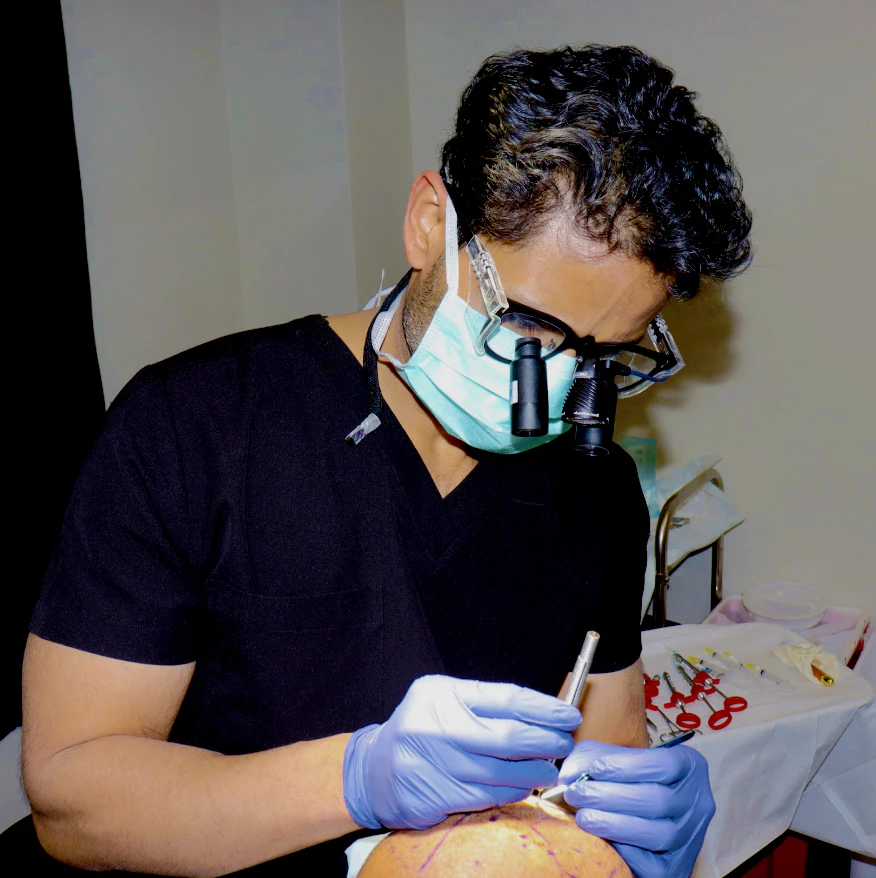
Dr. Shah's software-assisted pre-surgical planning allows him to optimize graft extraction within the safe donor area. The goal is to maximize graft yield while minimizing any visible reduction in donor density. This level of planning becomes even more critical in patients who have undergone previous procedures where a large number of grafts have already been extracted.
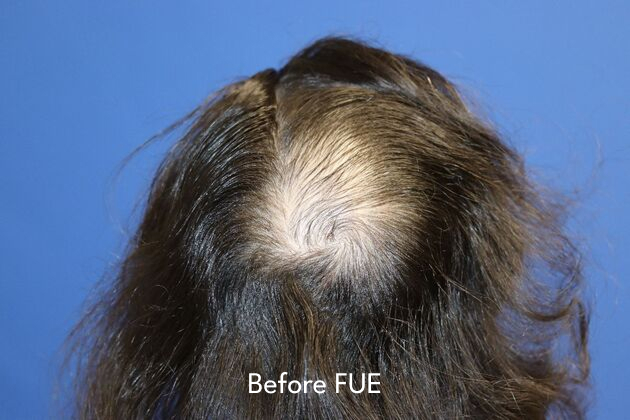
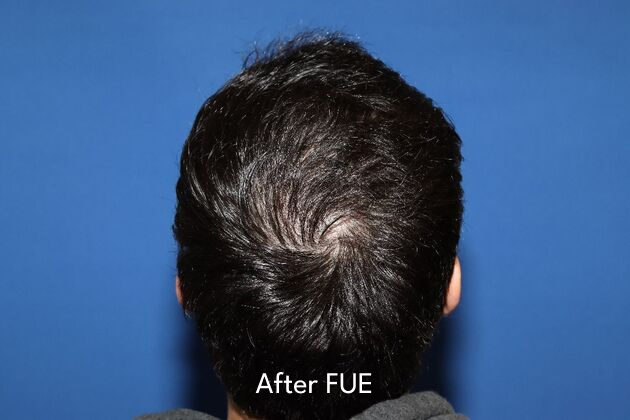
The photo on the right was taken six months after a follicular unit extraction (FUE) procedure by Dr. Shah. This 30-year-old man had vertex baldness, which Dr. Shah treated with a 1,550-graft FUE procedure. If you want to achieve natural-looking results that end your self-conscious feelings about your hair, it's time to consult Dr. Shah.
Thinning hair can cause an avalanche of insecurity. Why make it worse with results that make your scalp look unhealthy, scarred, or obviously restored using subpar techniques?
Dr. Shah's $7-per-graft fee reflects surgeon-performed precision: hand-placed grafts, custom incisions, and meticulous planning. When you look at his gallery of results, you'll see why discerning patients choose Dr. Shah over high-volume clinics. Let him deliver the exceptional outcome you deserve.
“As a plastic surgeon myself, I sought the best specialist for my hair restoration procedure, and found that person in Dr. Shah. I knew from his reputation that I would have a great experience, but the process itself was even better than I had anticipated. He listened to my concerns carefully and together we came up with a strategy for my procedure, which he carried out exactly as we had discussed.”
"Unlike many other clinics, he is personally involved in every step of the process, from start to finish, and this shows in his exceptional results. His meticulous attention to detail and genuine passion for hair restoration stand out. Overall, he is outstanding, and I now highly recommend him not only to my closest friends and family members but also to my fellow physician and surgeon colleagues."
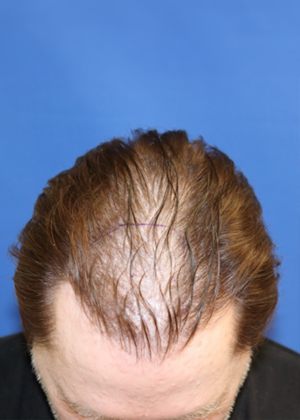
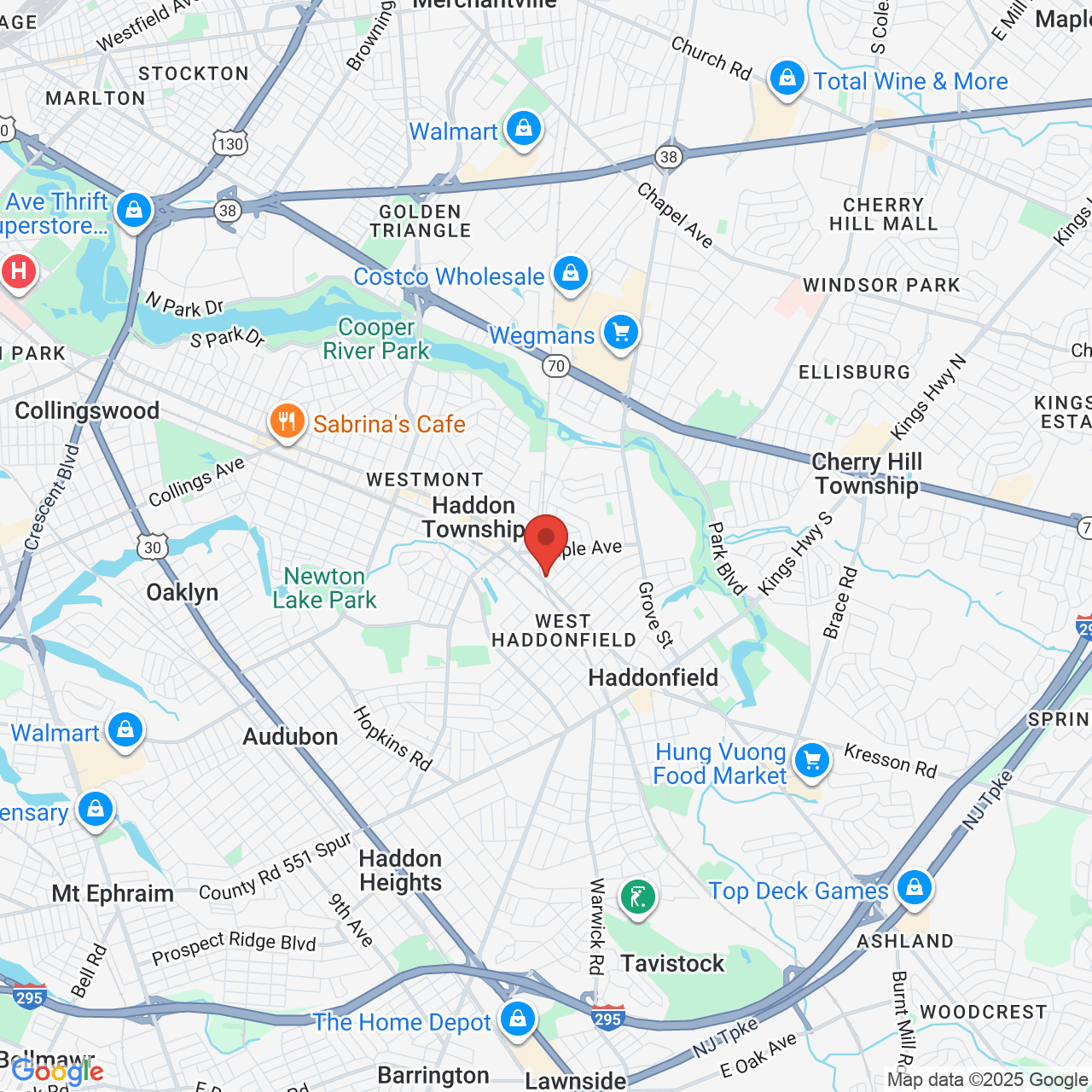
One year after a multi-step FUE treatment, this patient in his early 30s has a restored front and mid-scalp. If hair loss is affecting your confidence, Dr. Shah can deliver the natural-looking outcome you want and deserve. It all starts with a consultation at his Haddonfield office serving Greater Philadelphia.
Medications like finasteride are an effective way to maintain your results after an FUE procedure, but we understand that many men do not want to take these drugs due to the small risk of sexual side effects that they carry.
Choosing to undergo a FUE hair transplant in Philadelphia from Dr. Shah as a first-time hair restoration patient can set the stage for natural-looking outcomes if you decide to undergo a subsequent procedure. Again, this is due to Dr. Shah's use of advanced software to evaluate each follicle area that will be harvested, and his use of custom incisions that precisely accommodate each follicle without undue trauma. A subsequent FUE procedure can build upon your initial results in a way that maintains a natural-looking scalp.
The cost of FUE is based on the complexity of your case. At a starting rate of $7 per graft, Dr. Shah's fee reflects the premium standard of surgeon-performed care: every incision is custom-designed, every graft is placed by hand using his proprietary stick-and-place technique, and every patient receives the precision that distinguishes world-class outcomes. This investment in excellence is how Dr. Shah achieves results that other practices cannot replicate.
The two most important cost factors are your hair type and the number of grafts you need. Gray hair and African hair are more difficult to work with, so patients with these hair types can expect to pay more. During your consultation, Dr. Shah can provide you with an estimated cost of treatment.
Dr. Shah works with CareCredit®, a third-party lender that makes it easy to take advantage of low-interest and interest-free financing for elective medical procedures. It won't affect your credit score to find out if you qualify.
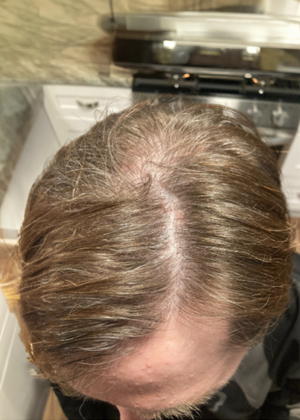
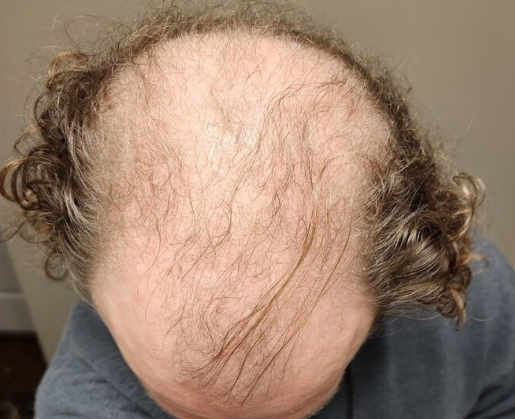
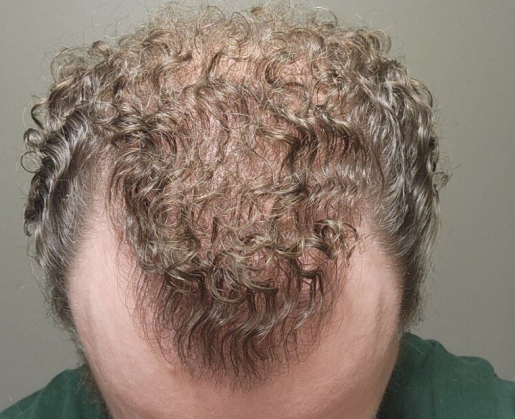
Dr. Shah used about 2,700 grafts harvested from this patient's scalp and beard to restore his mid-scalp and frontal hairline. In a second procedure, Dr. Shah transplanted follicles to the patient's crown. The image on the right shows his progress at 12 months after surgery. Click below to see how the patient looked immediately post-op, followed by images of his progress at 3, 4, 5, 6, 7, and 9 months after FUE.
While there are many advantages to choosing FUE, some patients are better candidates for FUT (follicular unit transplantation). Dr. Shah only performs FUE, but can refer patients to other trusted practices if they are better suited to FUT. Here is a look at some of the reasons why Dr. Shah recommends FUE to the right candidates:
Unlike FUT, FUE requires no sutures or staples, resulting in less trauma to the scalp.
FUE patients can usually resume normal activities within several days. FUT patients commonly need to take at least a week off work. Initial healing can take up to a month.
FUT leaves a linear scar in the donor area. FUE involves only small dot-like scars that are virtually unnoticeable.
FUE can be based on the selective extraction of hair follicles. If there is limited viable donor hair in the scalp, follicles can also be harvested from the beard and other areas of the body.
FUE can be a highly effective way to restore a full, natural-looking head of hair, but it’s not right for everyone. Dr. Shah will assess all of this during your consultation. No phase of his treatment is ever rushed, and that holds true from the very first time you meet to discuss your goals. The best FUE candidates share a few traits:
If you feel unsatisfied with the results of an initial hair restoration procedure, FUE by Dr. Shah could be the very best way to finally achieve the results you wanted from the start.
Dr. Shah understands that you don't want the donor area looking any thinner. Thanks to his digital planning software and refined stick-and-place technique, he can leave the donor area looking healthy while transferring hair in a way that causes virtually unnoticeable scarring.
If you have suffered the disappointment and self-consciousness that result from an undesirable hair restoration outcome, Dr. Shah wants you to know that there is hope for a full, healthy head of hair that makes you feel ready to take on the world. Write to us or give us a call to request your consultation.
Patients heal at different rates, but in general, this is what FUE patients can expect to experience in the weeks and months following treatment:
“This was my 3rd transplant and 3rd different surgeon but by far this was the best experience I've had. Dr. Shah is a true professional and cares about the patient and his quality of work. You won't be sorry, don't go overseas, get your hair back now with someone you can trust.”
Jason, 5-Star Review
Patient education is an essential part of successful hair restoration surgery, and Dr. Shah wants to help you make an informed decision. Below you'll find answers to some of the most commonly asked questions about FUE; if you have more questions, request your consultation today!
It's normal to notice some initial shedding of the transplanted hair shafts within 2 to 4 weeks. The hair follicle stays intact below the scalp, and new hair usually grows within a few months. It might take 6 to 12 months before the full results are apparent. Your hair will become thicker and denser over time.
FUT involves removing a strip of the scalp and dissecting it into individual follicles before they are transplanted. FUE is far less invasive. It involves extracting follicles one by one, which results in virtually unnoticeable scarring and a faster recovery. However, not everyone is an FUE candidate; if he believes you might be a better FUT candidate, Dr. Shah can refer you to a trusted colleague.
Thanks to local anesthesia, you can expect little or no discomfort during the surgical procedure. Once the local anesthesia wears off, you might experience some mild discomfort that can be managed with over-the-counter pain meds.
Welcome to BKS Hair Restoration, led by Dr. Bhumik Shah. Our expert team is proud to serve Haddonfield, Philadelphia, and surrounding areas with personalized, cutting-edge hair loss solutions. Dr. Shah is:
Say goodbye to hair loss and take the first step toward regaining your confidence. Book your consultation online today or call us at (856) 470-1398 to get started.